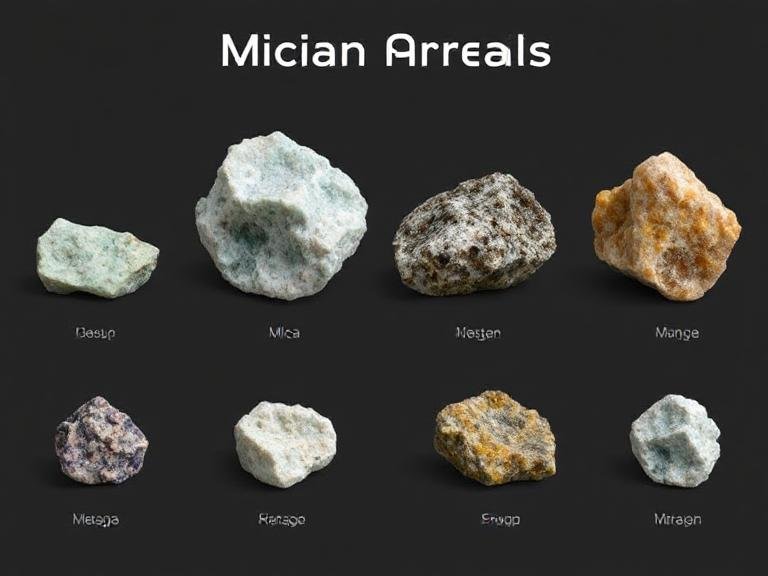


Strengthening and Toughening Plastic Products with Mica Powder: A Comprehensive Guide
The demand for high-performance plastic materials continues to grow across industries, driving the need for effective reinforcement solutions. Mica powder has emerged as a valuable additive for enhancing both mechanical strength and impact resistance in plastic products. This naturally occurring mineral offers unique advantages when properly incorporated into polymer matrices, addressing common challenges in plastic product development.
Mica’s Structural Advantages for Plastic Reinforcement
Mica belongs to a group of sheet silicate minerals characterized by their layered atomic structure. When processed into fine powder, these layers create platelet-shaped particles that provide exceptional reinforcement in plastics. The high aspect ratio (length-to-thickness ratio) of mica particles creates a reinforcing network within the polymer matrix, effectively distributing stress and preventing crack propagation.
The inherent hardness of mica (Mohs scale 2.5-4) contributes significantly to its reinforcing effect. When incorporated into plastics, mica particles resist deformation under load, increasing the composite material’s overall stiffness. This property makes mica particularly valuable in applications requiring dimensional stability under mechanical stress or thermal cycling.
Chemical compatibility plays another crucial role. Mica’s stable aluminum silicate structure maintains its integrity across a wide pH range and shows excellent resistance to most organic solvents. This stability ensures consistent reinforcement performance even in harsh operating environments or when exposed to aggressive chemicals.
Mechanisms of Strength and Toughness Enhancement
Stress Distribution Improvement
Mica particles act as stress concentrators that redirect applied forces throughout the polymer matrix. When stress is applied to a mica-reinforced plastic, the platelet-shaped particles distribute the load across their broad surfaces rather than allowing it to concentrate at specific points. This mechanism prevents the formation of micro-cracks that could lead to catastrophic failure.
The orientation of mica particles also influences reinforcement effectiveness. In injection-molded parts, flow-induced alignment creates anisotropic properties where strength and toughness vary with direction. Controlled particle orientation can be achieved through processing parameter adjustments to optimize performance for specific loading conditions.
Crack Propagation Resistance
The layered structure of mica creates tortuous paths for crack growth through the polymer matrix. When a crack encounters a mica particle, it must either deflect around the platelet or force its way through the strong silicate layers. Both scenarios require additional energy, effectively increasing the material’s impact resistance and fracture toughness.
This crack-deflection mechanism becomes particularly important in applications involving repeated impact or cyclic loading. Mica-reinforced plastics demonstrate improved fatigue resistance compared to unmodified polymers, maintaining their mechanical integrity through thousands of stress cycles.
Interfacial Bonding Enhancement
Effective reinforcement requires strong adhesion between mica particles and the polymer matrix. Surface treatments can modify mica’s hydrophilic surface to improve compatibility with hydrophobic polymers. Common modification techniques include silane coupling agents that form chemical bridges between the mineral and polymer chains.
The quality of interfacial bonding directly affects the composite’s mechanical properties. Well-bonded mica particles transfer stress efficiently to the polymer matrix, while poor bonding creates weak points that compromise reinforcement. Optimal surface treatment selection depends on the specific polymer type and processing conditions.
Application-Specific Performance Benefits
Automotive Components
In automotive applications, mica-reinforced plastics offer significant advantages for both interior and exterior parts. Dashboard components benefit from improved dimensional stability under temperature variations, while exterior trim parts show enhanced resistance to stone chipping and environmental degradation. The weight reduction compared to metal alternatives remains a key advantage.
Engine compartment components particularly benefit from mica’s thermal stability. Underhood plastics reinforced with mica maintain their mechanical properties at elevated temperatures, resisting deformation that could affect component fit or function. This thermal resistance also helps prevent warping in parts exposed to direct sunlight.
Consumer Electronics
The thin-walled, complex geometries common in consumer electronics demand materials with excellent flow properties during molding combined with post-molding strength. Mica-reinforced plastics provide this balance, enabling the production of lightweight yet durable cases and housings. The mineral’s electrical insulating properties also offer advantages in certain electronic applications.
Impact resistance becomes critical for portable devices that may experience drops or impacts during use. Mica reinforcement helps prevent catastrophic failure by absorbing and distributing impact energy throughout the part. This toughness enhancement extends product lifespan and improves user satisfaction.
Construction Materials
In building and construction applications, mica-reinforced plastics offer improved performance for pipes, profiles, and panels. The reinforcement increases flexural strength, allowing the use of thinner sections without sacrificing load-bearing capacity. This weight reduction translates to easier handling and installation while maintaining structural integrity.
Weather resistance receives particular enhancement from mica addition. The mineral’s stability under UV exposure helps prevent degradation of polymer chains, maintaining mechanical properties over extended service life. This durability makes mica-reinforced plastics valuable for outdoor applications exposed to harsh environmental conditions.
Processing Considerations for Optimal Performance
Dispersion Techniques
Effective dispersion of mica powder is essential for realizing its reinforcement potential. High-shear mixing equipment helps break down particle aggregates and ensures uniform distribution throughout the polymer matrix. The choice of mixing method depends on the polymer type, with twin-screw extruders often preferred for thermoplastics.
Carrier resins can improve mica dispersion in some formulations. These compatible polymers help separate mica particles during processing before they become incorporated into the final matrix. The carrier resin must be carefully selected to avoid compromising the composite’s overall properties.
Particle Size Selection
Mica powder comes in various particle size distributions, each offering different reinforcement characteristics. Finer particles (below 20 microns) provide better surface finish and may be preferred for visible parts, while coarser grades (above 45 microns) offer greater reinforcement at lower loading levels. The optimal size depends on the specific application requirements.
Aspect ratio maintenance during processing is critical. Excessive shear during compounding can break down mica platelets, reducing their effective aspect ratio and compromising reinforcement. Processing parameters must balance effective dispersion with particle integrity preservation.
Loading Level Optimization
The optimal mica concentration varies depending on polymer type and application requirements. Generally, loading levels between 5-20% by weight provide noticeable improvements in strength and toughness without significantly affecting processability. Higher concentrations may offer additional reinforcement but could require processing modifications to maintain flow properties.
Synergistic effects can occur when combining mica with other additives. For example, blending mica with glass fibers may create complementary reinforcement mechanisms, though careful formulation is required to avoid processing difficulties. The interaction between mica and other formulation components should be evaluated during development.
Emerging Trends and Future Directions
Research continues to explore new ways to enhance mica’s reinforcement capabilities in plastics. Surface modification techniques are evolving to create more specific interactions with different polymer types. Nanoscale mica particles represent an exciting frontier, offering the potential for even greater reinforcement at lower loading levels.
Sustainability considerations are influencing mica processing methods. The industry is developing more energy-efficient grinding techniques and exploring recycling possibilities for mica-reinforced plastics at end-of-life. These efforts align with broader goals of reducing the environmental impact of plastic products throughout their lifecycle.
Functionalized mica particles with tailored properties are also under investigation. By attaching specific chemical groups to mica surfaces, researchers aim to create additives that not only reinforce but also impart additional functionality such as flame retardancy or antimicrobial properties. This multi-functional approach could open new application areas for mica-reinforced plastics.
The development of mica hybrid systems combining the mineral with other reinforcement materials shows promise for specialized applications. These combinations could leverage the unique advantages of each component to create plastics with customized property profiles for demanding engineering applications.