
Mica Shimmer Powder in Handmade Soap: The Natural Mineral That Makes Bars Look Expensive
Walk into any artisan soap shop and the first thing you notice is not the scent. It is the sparkle. Swirled iridescent bars on wooden shelves, tiny flecks of gold and copper catching the light, whole loaves that look like they came from a boutique in Provence. Most of that shimmer comes from one ingredient: mica powder.
Cosmetic-grade mica has been used in soap making for decades, but it keeps gaining traction as natural and organic soap makers look for clean-label alternatives to synthetic glitter and petroleum-based colorants. The mineral is naturally occurring, non-toxic, heat-stable enough to survive cold-process saponification, and it does not bleed or fade the way some organic pigments do.
The tricky part is getting the color right. Mica powder does not come in a rainbow of shades straight from the bag. It is a mineral substrate that gets coated with metal oxides to produce color — and those coatings behave very differently inside a soap matrix than they do on a swatch card. Understanding how mica interacts with lye, oils, and curing time is the difference between a bar that shimmers beautifully and one that turns muddy gray within a week.
How Mica Powder Actually Colors Soap
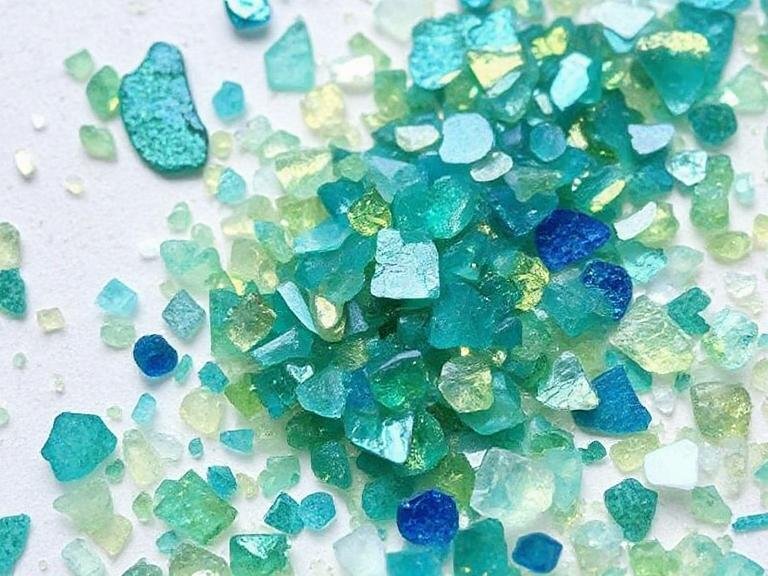
Mica is a sheet silicate — think of it as a stack of ultra-thin transparent plates. The base mineral itself is colorless or slightly pearlescent. The colors you buy — gold, rose, teal, violet — come from thin layers of metal oxides deposited on the mica surface during manufacturing. Iron oxide gives red and gold. Titanium dioxide gives white and silver. Chromium oxide gives green. Cobalt gives blue.
When you mix mica powder into soap batter, you are not dissolving the pigment into the soap. You are suspending thousands of tiny mirror-like platelets inside a solid fat matrix. The color you see depends on three things: the oxide coating on the mica, the thickness of that coating, and the angle at which light hits the platelet surface.
This is why mica in soap looks different from mica in paint. In paint, the mica is suspended in a liquid binder that levels out during drying, so most platelets lie flat and you see a uniform color. In soap, the batter thickens quickly and traps platelets in random orientations. Some lie flat, some stand on edge, some tilt at angles. Light bounces off each platelet at a different angle, so you get that characteristic multi-dimensional shimmer — color shifts as you turn the bar under a lamp.
That shift is what makes mica so desirable for decorative soap. Synthetic pigments give you flat, one-dimensional color. Mica gives you depth and movement. A bar colored with iron oxide mica looks copper from one angle and gold from another. That living quality is impossible to replicate with any other natural colorant.
Why Some Mica Colors Turn Muddy in Soap
The most common complaint from soap makers new to mica is that the color looks gorgeous in the batter but turns dull or gray after curing. This happens for several reasons, and almost none of them are the mica’s fault.
First, particle size matters enormously. Coarse mica — above 50 micrometers — settles out of the batter before it thickens and ends up concentrated at the bottom of the mold. The top of the bar looks pale, the bottom looks dark and muddy. Fine mica — below 20 micrometers — stays suspended better but can clump in the lye solution if you dump it in dry. The clumps trap air and create dull spots.
The sweet spot for cold-process soap is 10 to 25 micrometers. At this size, the platelets suspend evenly through the batter, orient randomly when the soap sets, and produce consistent shimmer from top to bottom of the bar.
Second, the pH of soap batter is brutally alkaline — typically 9 to 10 during saponification. Some mica coatings are not stable at that pH. Iron oxide coatings hold up fine. But certain organic-based color coatings — the ones that produce bright pinks, purples, and teals — can degrade in high pH, losing their color or shifting hue. The mica platelet itself is inert, but the coating on it is not always alkali-resistant.
This is why some soap makers pre-mix mica with a small amount of oil or glycerin before adding it to the lye. The oil coating buffers the mica from direct contact with the alkaline batter, protecting the pigment layer during the critical first few hours when pH is highest. Once saponification is complete and the pH drops to around 8–9, the coating is stable and the color locks in permanently.
Temperature Stability and Soap Making Methods
Cold Process vs Hot Process vs Melt and Pour
Mica behaves differently in each soap making method, and choosing the wrong grade for your method is the fastest way to ruin a batch.
In cold-process soap, the batter never exceeds about 60°C — the heat of saponification itself. Most cosmetic mica grades handle this easily. The platelets disperse into the batter, suspend, and set in place as the soap hardens over 24–48 hours. The color you pour is the color you get, more or less.
Hot-process soap is a different story. The batter gets cooked to 80–100°C in a crockpot or slow cooker to accelerate saponification. At those temperatures, some mica coatings start to degrade — particularly the organic-based blues and greens. The iron oxide golds and bronzes are fine up to 300°C, so they survive hot process without issue. But if you are making a teal or violet hot-process soap, test the mica first by mixing a small amount into boiling water and seeing if the color holds.
Melt-and-pour soap is the most forgiving. The base is already saponified, so you are just melting it down and adding color. Temperatures stay below 80°C, and there is no lye to worry about. Mica disperses easily into melted glycerin soap or goat milk base, and the colors stay vivid because there is no chemical reaction happening — you are just suspending pigment in a solid.
The downside of melt-and-pour is that the soap base is often translucent, which means mica platelets near the surface can look chalky or powdery instead of shimmery. The trick is to embed the mica deep in the batter — pour half the base into the mold, sprinkle the mica, then pour the rest on top. The mica sits in the middle layer where light passes through the translucent soap on both sides, producing that deep, glowing effect.
How Much Mica to Use Without Ruining the Bar
The temptation is to load up on mica because more sparkle looks better. It does not. Past a certain concentration, mica makes soap feel gritty, looks dusty, and can even irritate sensitive skin.
For cold-process soap, the practical limit is about 1 to 2 teaspoons of fine mica powder per pound of oils — roughly 0.5 to 1% by weight. That sounds like very little, but mica is extremely reflective. Even 0.5% loading produces visible shimmer. Going above 1.5% starts to affect texture — the soap feels sandy when you lather it, and the mica can clog the mold if you try to swirl it.
For melt-and-pour, you can push slightly higher — up to 2% — because the base is softer and the mica integrates more smoothly. But even here, more than 2% gives a gritty, glittery finish that looks cheap rather than artisan.
One technique experienced soap makers use is layering. Instead of mixing mica throughout the entire batch, they color only the top layer — maybe the last quarter inch of batter poured into the mold. The top shimmers, the bottom is a solid color, and the contrast looks intentional and high-end. This uses less mica overall and avoids the gritty texture problem.
Swirl Techniques and Color Blending With Mica
Creating Marble and Swirl Effects
The most popular decorative technique with mica in soap is swirling — pouring two or three colored batters into the mold in alternating layers, then dragging a skewer through them to create marble patterns. Mica is ideal for this because the platelets stay suspended long enough for you to work with them, and the random orientation in each layer catches light differently, so the swirl looks three-dimensional rather than flat.
The key to good swirls with mica is consistency. The batter must be thick enough to hold the mica in suspension but fluid enough to pour. Too thin and the mica sinks to the bottom of each pour, creating dense layers with pale layers in between. Too thick and you cannot get the batter to flow into the mold corners, and the skewer drag looks choppy instead of smooth.
Most soap makers using mica aim for a thin trace to medium trace consistency — the batter should pour slowly off a spatula in a ribbon that holds its shape for a second or two before sinking back. At this consistency, mica platelets stay evenly distributed throughout the pour.
For multi-color swirls, use mica colors that contrast well. Gold and teal is classic. Rose and copper is warm and rich. White mica with a splash of black oxide gives a dramatic marble effect. Avoid pairing two similar colors — gold with bronze, for example — because the swirl disappears and the bar just looks muddy.
Using Mica With Other Natural Colorants
Mica plays well with most natural soap colorants, but there are a few pairings that cause problems.
Activated charcoal is the worst offender. Charcoal is a powerful adsorbent — it grabs onto mica platelets and pulls them out of suspension. If you try to swirl charcoal soap with mica, the mica migrates toward the charcoal layers and concentrates there, leaving the white layers pale. The fix is to add the mica to the charcoal batter last, mix quickly, and pour immediately before the charcoal has time to adsorb the platelets.
Indigo powder and ultramarine blue work fine with mica. They are both powder pigments that suspend similarly, so they blend evenly. Turmeric and annatto are trickier because they are oil-soluble and tend to streak rather than swirl. Mica in a turmeric soap will create a glittery yellow-gold bar, but the turmeric itself may not swirl cleanly — it streaks in orange lines through the mica shimmer.
The best combination for complex decorative soap is mica plus a small amount of oxide pigment. Use the oxide for the base color — iron oxide for warm tones, chromium oxide for green, ultramarine for blue — and add mica on top for the shimmer. The oxide gives you solid, predictable color, and the mica adds the depth and movement that makes the bar look handcrafted and premium.
Skin Safety and Regulatory Considerations
Is Mica Safe for Soap That Touches Skin?
This question comes up constantly, and the answer depends on how you define safe. Cosmetic-grade mica is processed to remove heavy metal contaminants and is certified for use in cosmetics by regulatory bodies in the US, EU, and most other markets. The particle sizes used in soap — 10 to 25 micrometers — are too large to penetrate intact skin. They sit on the surface and wash off with water.
The concern that occasionally surfaces is about asbestos contamination. Some mica deposits occur near asbestos minerals, and historical mica mining sometimes produced cross-contaminated material. Modern cosmetic-grade mica is tested for asbestos and must meet strict limits — typically below detectable levels by polarized light microscopy. Reputable suppliers provide certificates of analysis for every batch.
If you are sourcing mica for soap making, buy from a supplier that specifically labels the product as cosmetic-grade or soap-safe. Do not use industrial mica, electrical mica, or mica from unknown sources. The risk is low but not zero, and a single bad batch can contaminate an entire production run.
For soap sold commercially, check your local regulations. The EU requires mica in cosmetics to meet specific purity criteria under the Cosmetics Regulation. The FDA does not pre-approve color additives for soap specifically, but cosmetic-grade mica is generally recognized as safe for external use. If you are selling at farmers markets or online, having a COA from your mica supplier protects you if a customer raises a safety question.
Mica and Sensitive Skin
Mica platelets are physically inert — they do not react with skin, do not dissolve, and do not release chemicals. For most people, mica in soap is no different from any other mineral filler. But for people with very sensitive skin or conditions like eczema, the physical texture of mica can be irritating. The platelets have sharp edges at the microscopic level, and if the soap is gritty from over-loading mica, it can abrade sensitive skin during lathering.
The solution is simple: use fine-grade mica below 15 micrometers and keep loading under 0.75% by weight. At these levels, the platelets are too small to feel gritty, and the soap lathers smoothly even on delicate skin.
One more note: mica does not rinse off completely. Tiny flecks stay on the skin after washing, which is actually part of the appeal for decorative soap — you want that subtle shimmer on your hands after you wash. But if you are making soap for people who want a clean, matte finish, mica is not the right choice. It is purely a decorative additive, not a functional one.
Storing Mica Powder and Preventing Color Shift
Moisture and Clumping Issues
Mica powder is hygroscopic — it absorbs moisture from humid air. When mica clumps, it does not disperse evenly into soap batter. You get streaks, specks, and dull patches where the clumps did not break apart during mixing.
Store mica in a sealed container with a desiccant packet. A mason jar with a silicone gasket lid works well. Keep it in a cool, dry place away from the soap making area — the humidity from lye solutions and steam from hot oils will accelerate moisture absorption if the mica is stored nearby.
If your mica does clump, do not try to break it up by shaking the jar. The clumps are held together by moisture bridges between platelets, and shaking just compresses them into harder lumps. Instead, spread the mica on a baking sheet and bake it at 80°C for 30 minutes. The heat drives off the absorbed moisture, and the platelets separate back into a free-flowing powder. Let it cool in a sealed container before using.
Preventing Oxidation of Metallic Mica Colors
Metallic mica colors — the bright golds, coppers, and silvers — use aluminum or aluminum-alloy coatings instead of metal oxides. Aluminum oxidizes when exposed to air, turning from bright silver to dull gray. In soap, this oxidation happens slowly but visibly over months. A bar that looked brilliant gold when you made it might look tarnished and brownish after six months on the shelf.
The fix is to store finished mica-colored soap in airtight packaging — wax paper, shrink wrap, or a sealed box. Limit light exposure. UV accelerates aluminum oxidation, so keep mica soaps out of direct sunlight.
Some soap makers add a thin layer of mica-free soap on top of the colored batter as a cap. The top layer acts as a UV shield, protecting the mica-rich layers beneath from light damage. This works well for loaf molds where the top surface is exposed during curing.
For metallic mica specifically, some suppliers offer coated grades where the aluminum layer is protected with a thin silica or polymer overcoat. These grades cost more but retain their shine for years instead of months. If you are making soap to sell or give as gifts, the coated metallic mica is worth the extra cost because the recipient sees the bar at its best, not after it has dulled on a shelf.