

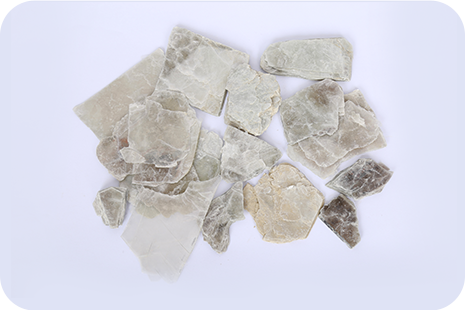
Visual Identification Techniques for Muscovite and Phlogopite
Distinguishing between muscovite (white mica) and phlogopite (golden mica) through visual inspection requires an understanding of their distinct physical and optical properties. These two mica varieties, while sharing similar layered structures, exhibit key differences in color, luster, transparency, and chemical reactivity that enable accurate identification without advanced equipment.
Color and Luster Characteristics
Muscovite typically displays a translucent to transparent appearance with a pearly or glassy luster. Its color palette ranges from colorless to pale hues such as light yellow, green, or pink, often attributed to trace mineral inclusions. When held against sunlight, high-quality muscovite thin sheets transmit light with minimal distortion, revealing internal clarity.
Phlogopite, in contrast, exhibits a metallic to semi-metallic luster with opaque to semi-transparent properties. Its dominant colors include golden yellow, brown, and greenish-brown, though some specimens may appear nearly black under certain lighting conditions. The reflective quality of phlogopite creates a shimmering effect, distinguishing it from muscovite’s softer sheen.
Practical Observation Tips
- Thin Sheet Comparison: Place both mica types on a white background and examine their edge transparency. Muscovite remains highly translucent, while phlogopite appears darker and less light-permeable.
- Surface Gloss Test: Tilt specimens under direct light. Muscovite reflects light uniformly, whereas phlogopite produces a brighter, more directional reflection due to its metallic components.
Optical Properties Under Polarized Light
When viewed through crossed polarizers, muscovite and phlogopite demonstrate unique interference colors—a result of their birefringent nature. Muscovite thin sections exhibit first-order gray to yellow interference hues, while phlogopite shows higher-order colors like blue or purple due to its greater birefringence.
Microscopic Clues for Field Identification
Though not always practical, a simple hand lens reveals critical details:
- Cleavage Planes: Both micas display perfect basal cleavage, but phlogopite’s cleavage surfaces often show subtle undulations compared to muscovite’s flatter planes.
- Inclusions: Muscovite may contain needle-like rutile or zircon inclusions, while phlogopite occasionally hosts opaque iron oxides or amphibole crystals.
Chemical Reactivity Tests
A basic acid test provides definitive differentiation:
- Muscovite: Resistant to concentrated sulfuric acid (H₂SO₄). Immersing a small fragment in acid for 30 seconds leaves the mineral structure intact.
- Phlogopite: Reacts vigorously with concentrated H₂SO₄, producing effervescence and dissolving into a milky suspension within minutes. This reaction stems from phlogopite’s higher magnesium content, which facilitates acid decomposition.
Safety Precautions for Chemical Testing
- Conduct reactions in well-ventilated areas.
- Wear protective gloves and eyewear.
- Neutralize acidic waste with baking soda before disposal.
Industrial Applications Linked to Properties
Understanding these differences aids in material selection for specific uses:
- Muscovite: Preferred for high-voltage electrical insulation due to its superior dielectric strength and thermal stability up to 700°C.
- Phlogopite: Utilized in high-temperature applications like furnace linings and brake linings, leveraging its ability to withstand temperatures exceeding 1000°C.
Real-World Identification Scenario
A geologist evaluating mica samples from a pegmatite deposit might:
- Separate specimens by color into translucent (muscovite) and metallic (phlogopite) groups.
- Perform acid tests on ambiguous samples to confirm identities.
- Cross-reference findings with known mineral associations—muscovite often coexists with quartz and feldspar, while phlogopite forms near magnesium-rich rocks like peridotite.
By mastering these visual and chemical identification methods, professionals can reliably distinguish muscovite from phlogopite, ensuring appropriate material usage across industries ranging from electronics to construction.